This week’s Parasha starts with the words “Re’eh Anochi Noten Lifneichem Hayom Bracha U’klalah.”
It means, “See, I am giving you a blessing and a curse today.”
G-d was speaking to all Jews.
So, what are our blessings and curse today?
The Parsha talks about the importance of following the laws of kashrut, do not worship idols, giving charity, observing the holidays, and so on.
But, perhaps, most importantly – don’t subtract or add to these laws.
As a heartbreak coach, I like to attempt to look through the lens of G-d as I remember that He made us in his image. And there are two personality images.
One is afraid to be vulnerable because it may mean one can lose their independence and control.
The other personality is the one who isn’t afraid to be vulnerable because it recognizes that’s what humans connect with love.
But can it be like every human made in His image, He too can flip and smite us out at any moment. Of course, He does.
Had it not been for Moishe’s begging and pleading, the Jewish people would not have survived beyond the sin of the golden calf. They would have all died after the Korach rebellion or the other eight times they sinned and complained, as mentioned in the previous parashiyot.
So, it might be wise to remember that, like us humans, G-d has His limits and should not be tested. However, unlike us mere mortals, we are comforted in knowing He is forever forgiving, which may be something we sometimes underestimate.
Good versus Evil – Blessing versus Curse
In other cultures, the word karma is tossed about. What it means is the good you do will come back to you, and the evil you do will, well – that comes back to you too. Could that concept work when Hashem instructs us to keep the commandments (blessing)? Would straying from His commandments lead to evil (curse)?
Like the personality who doesn’t like being put in a vulnerable position, G-d turned away when the Jews forgot Him while they were in Egypt for 430 years. They were waiting for a king to save them, implying that G-d wasn’t good enough. That must have hurt. But just as quickly, G-d was vulnerable to forgive them and saved them from pain and sorrow.
The story goes that while they were still in Egypt, they showed little faith that Moishe could help them through G-d. They complained when they left Egypt, doubting G-d could save them after seeing the miracle of the red sea, after being saved from the Egyptian shoulders. All G-d had asked for was faith, and He asked us to accept His love. Until then, G-d didn’t give the people he asked to choose him laws. He probably thought his love with being reciprocated. But at some point, he probably thought, these people need some rules to let them know my expectations.
A long time ago, I met a man, and we started a relationship. He asked me what I expected, and I said nothing. I loved him and didn’t want anything in return except respect, commitment to our relationship, and reciprocity. I didn’t state that as I thought it was understood. After some time, I began to feel taken for granted, so I spoke up. He turned his back to me, and I started to pull back as well, hoping he would perhaps realize that I truly loved him and that maybe we could have a happy future together. After some time, he returned, and I loved him just as I did before. He, of course, got comfortable again and started to take me for granted.
Now it was time to come to the table with rules, which I hated but saw that it was necessary if we were going to move forward.
Until the sin of the golden calf, where G-d saw the Jews worshiping another “god” or being cheated on, He probably didn’t think He needed to ask these people to show up for Him as He has been there for them.
Now, what is good and what is evil, or the blessing and the curse? We risk losing something excellent and wholesome when we don’t follow a relationship’s laws. When we don’t follow Hashem’s laws, we risk him stepping out of our lives, and only chaos ensues when G-d is absent.
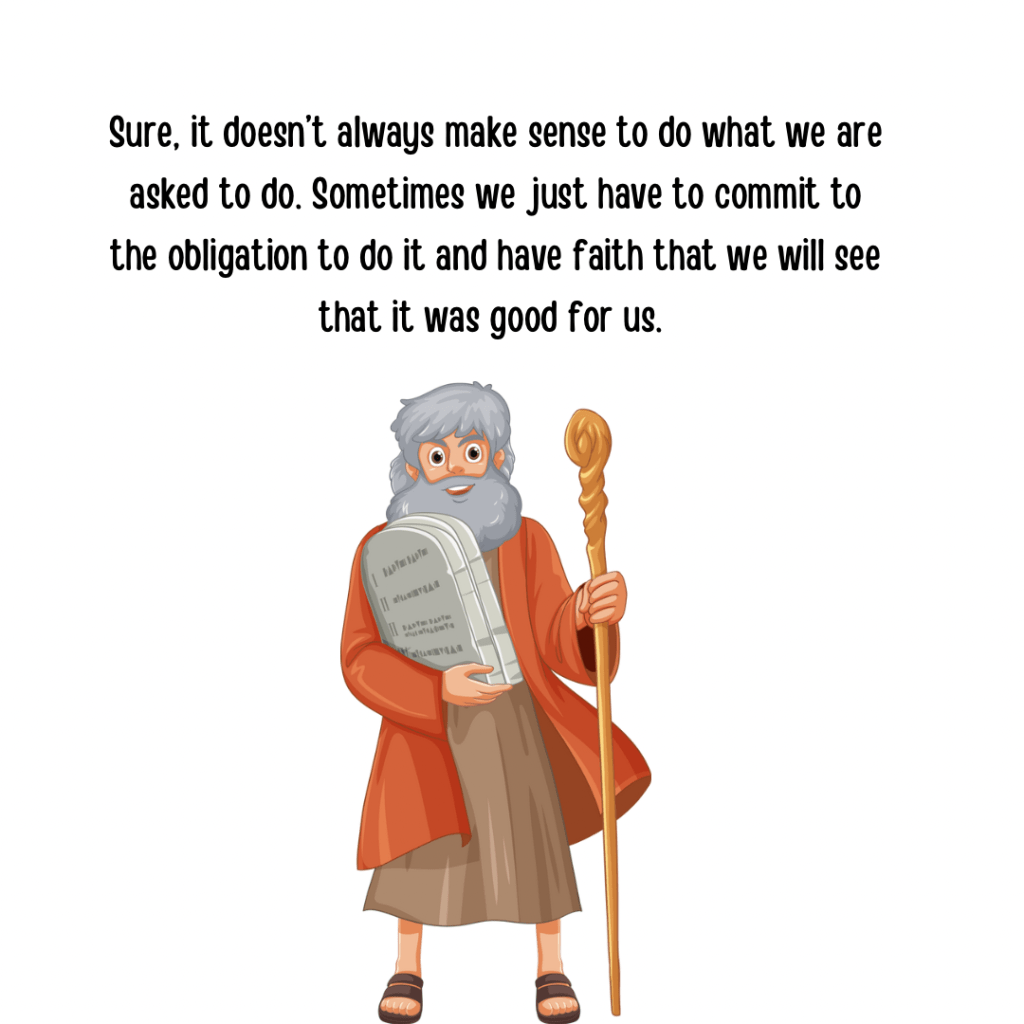
He recognized He needed to set these laws down; weirdly enough, if we look closely at these laws, they provide us an emotional and mental grounding in today’s world. They also set us up for the world to come. I only see us benefiting from fulfilling these mitzvot. Perhaps when I meet Hashem, He will tell me what was really in it for Him. For now, I am grateful that I have these rules to keep me on a fulfilling path.

 Shabbos Table
Leave a comment